The 1-0 Bias: Why Fans Miss the Exact Score
We named it the 1-0 Bias. Across 1.2 million predictions on ScorePlay, fans pile into 1-0, see a 1-goal game everywhere, and miss almost every draw. The data, and what really separates skill from luck.
Every football fan thinks they can call a scoreline. So we checked all of them. Across 1.2 million predictions and 1,752 matches on ScorePlay, from the Premier League, Serie A, La Liga, Bundesliga, Ligue 1 and the Champions League to Brazil's Série A, the Club World Cup and the start of the 2026 World Cup, one habit holds everywhere: fans predict football tidier than it plays. They reach for 1-0, treat almost every game as a one-goal affair, and rarely call a draw. We call it the 1-0 Bias.
The winner is easy
Pick the winner and you are right 38.8% of the time. Call the exact score and you drop to 6.3%, about six times harder, on the same matches.
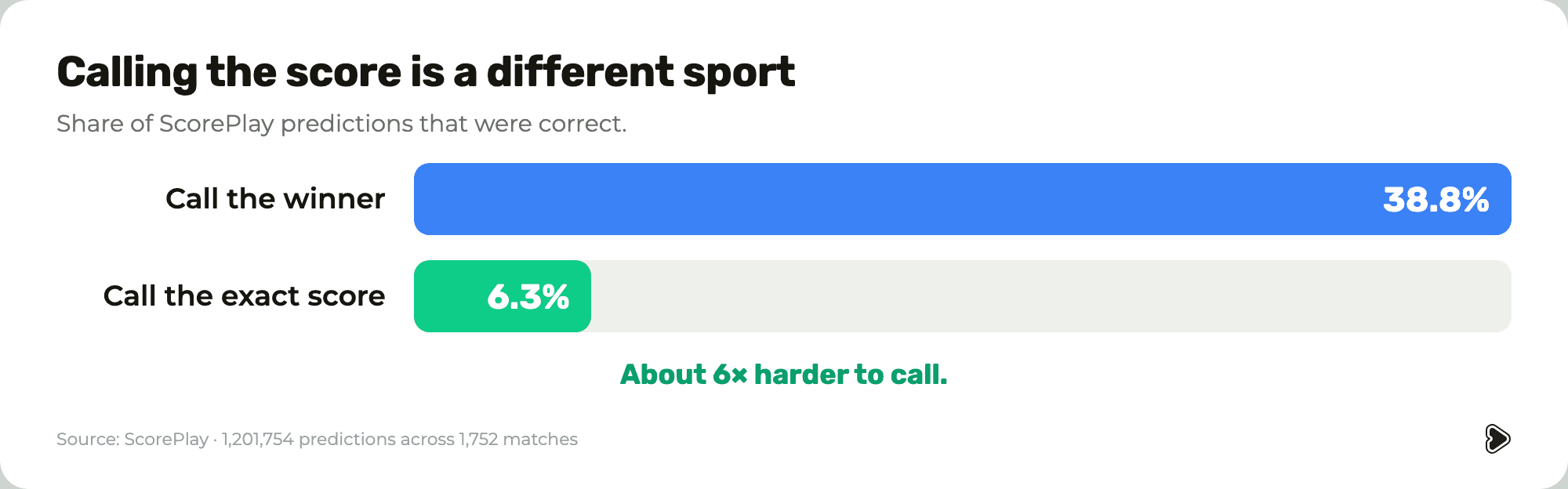
The winner is three options. The exact score is a grid of dozens, and across more than a million calls the crowd keeps funnelling into the same few cells.
Reason one: the same few scores
1-0 and 0-1 are the two most common predictions on ScorePlay, ahead of everything else by a clear distance. Together they make up nearly a third of every call ever logged.
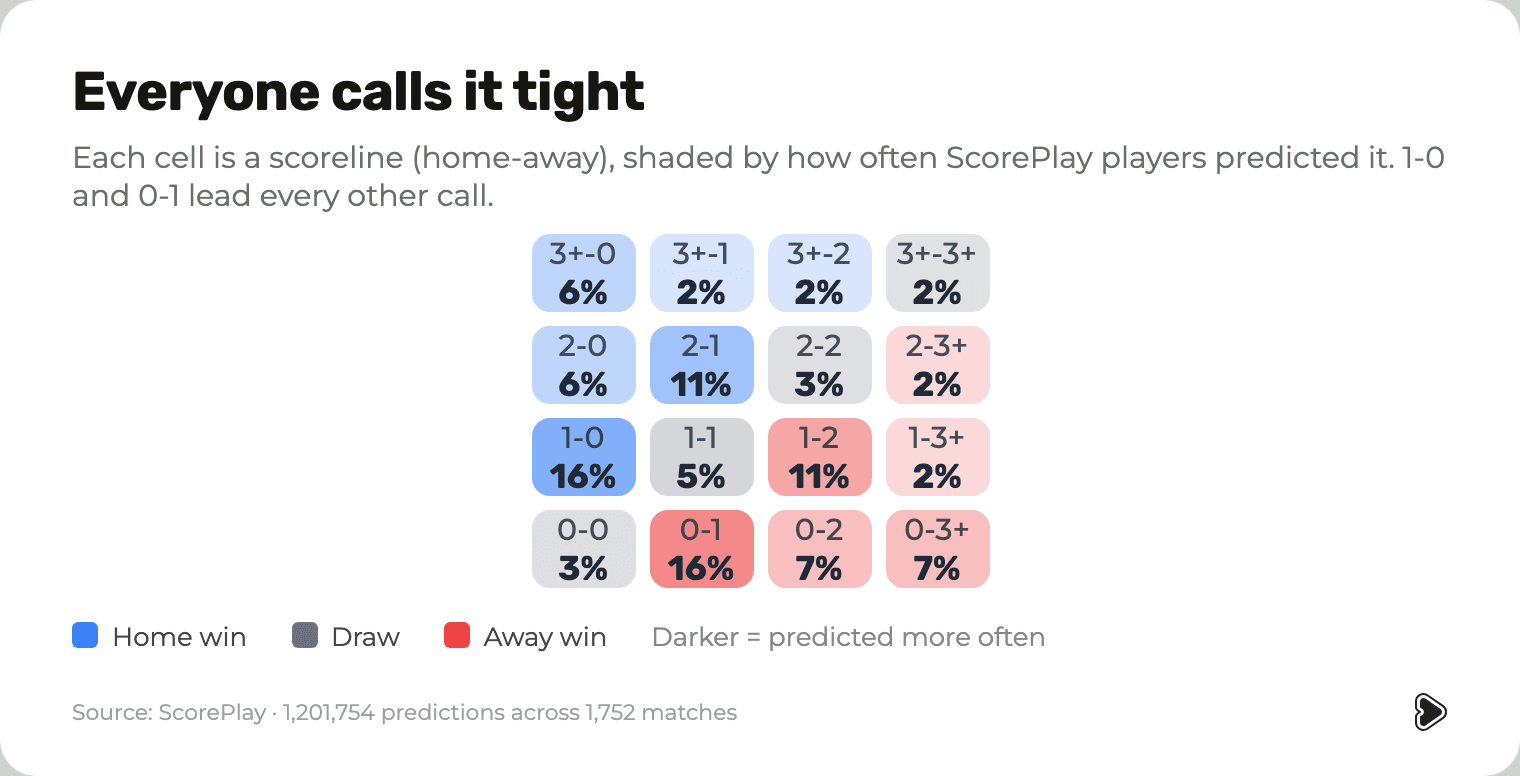
1-0 is the most common scoreline in real football, so leaning that way makes sense up to a point. The trouble is how far the crowd leans, and what it gives up to get there.
| Most predicted scoreline | Share of all predictions |
|---|---|
| 1-0 | 15.9% |
| 0-1 | 15.7% |
| 2-1 | 10.8% |
| 1-2 | 10.7% |
| 0-2 | 6.7% |
Reason two: a one-goal game everywhere
Look at the winning margin instead of the exact score and the bias is stark. Players call a one-goal margin 56.9% of the time. Only 38.9% of matches finish that close. Goals run the same way: the average prediction lands at 2.55 a match against a real 2.99.
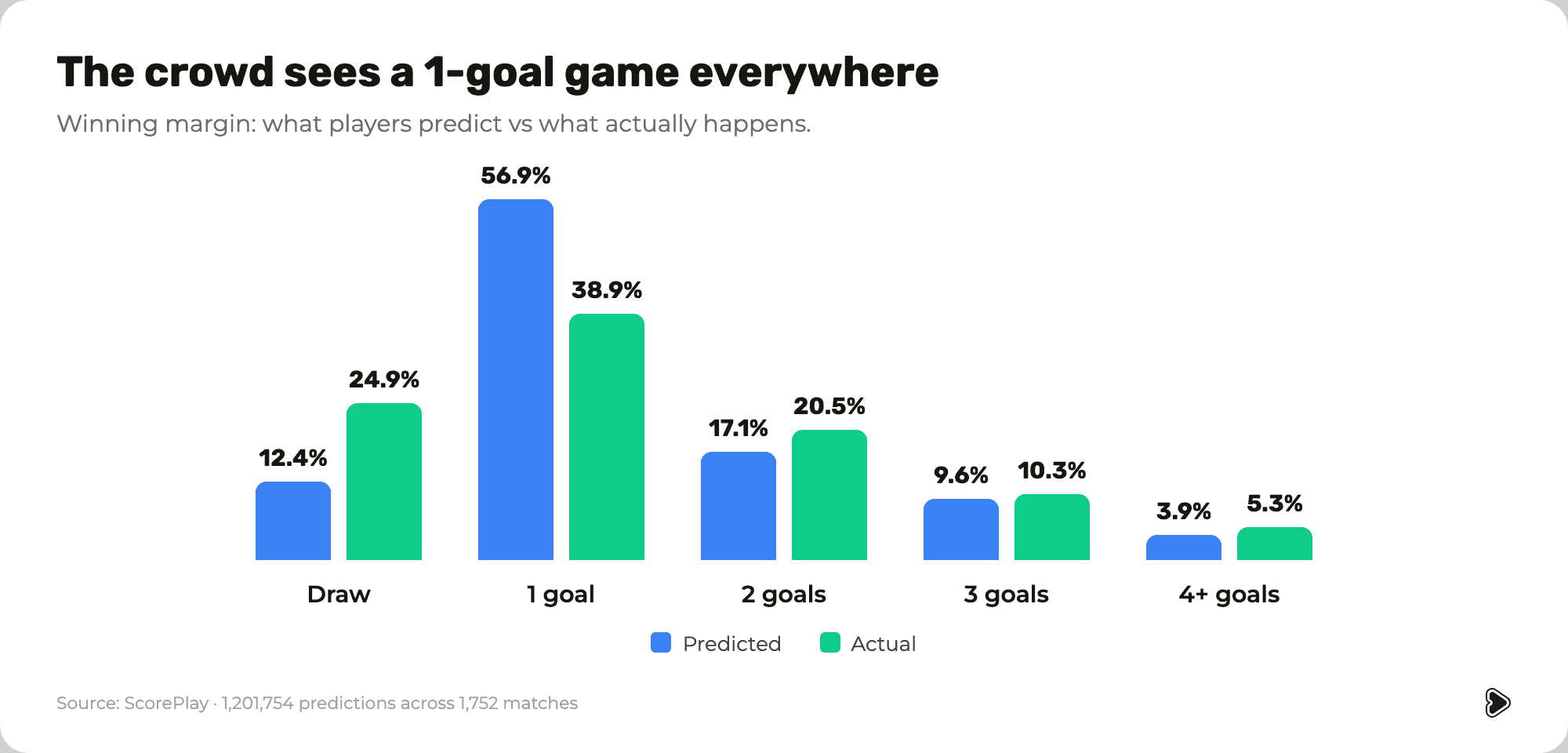
A one-goal win reads as a controlled, professional result, so the crowd reaches for it by default. Football spreads itself wider, into the blowouts and the level games the crowd skips.
Reason three: no draws
The level games are the sharpest blind spot. Draws happen in 24.9% of matches. Fans call them 12.4% of the time and pour the difference into the away win: 44.1% predicted against 30.5% real.
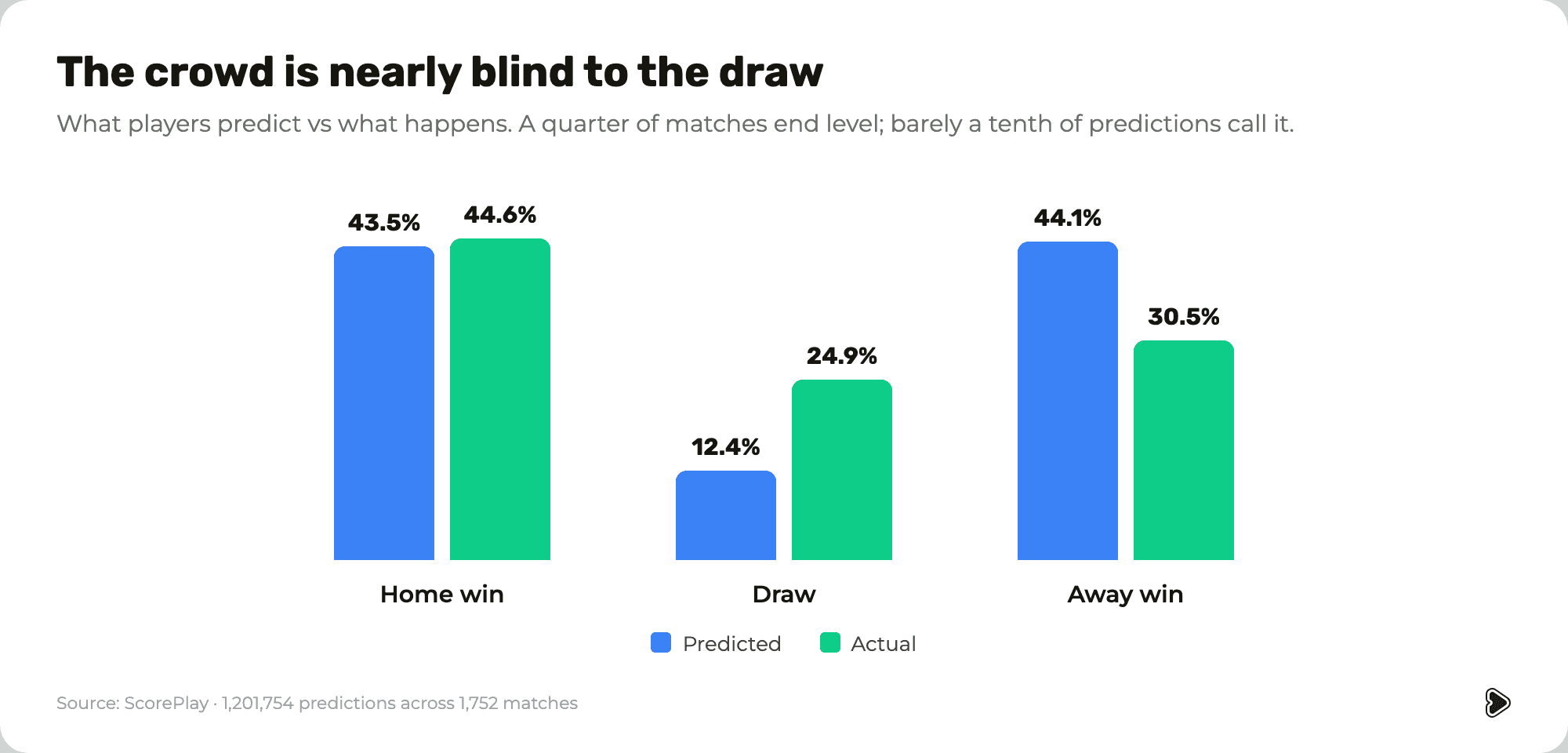
A draw has no hero and no favourite collecting their due. Both teams finish level and it feels like nothing was settled, so fans look past it. Football produces one roughly every four matches regardless.
Where it breaks
The pattern shows up cleanly at the World Cup. The matches the crowd nailed there were all tight, one-goal games:
- Benfica 1-0 Bayern Munich: 37.5% called it exactly
- LAFC 0-1 Esperance: 36.9%
- Atletico Madrid 1-0 Botafogo: 33.1%
The open, high-scoring games are another story, and PSG vs Real Madrid is the clean example.
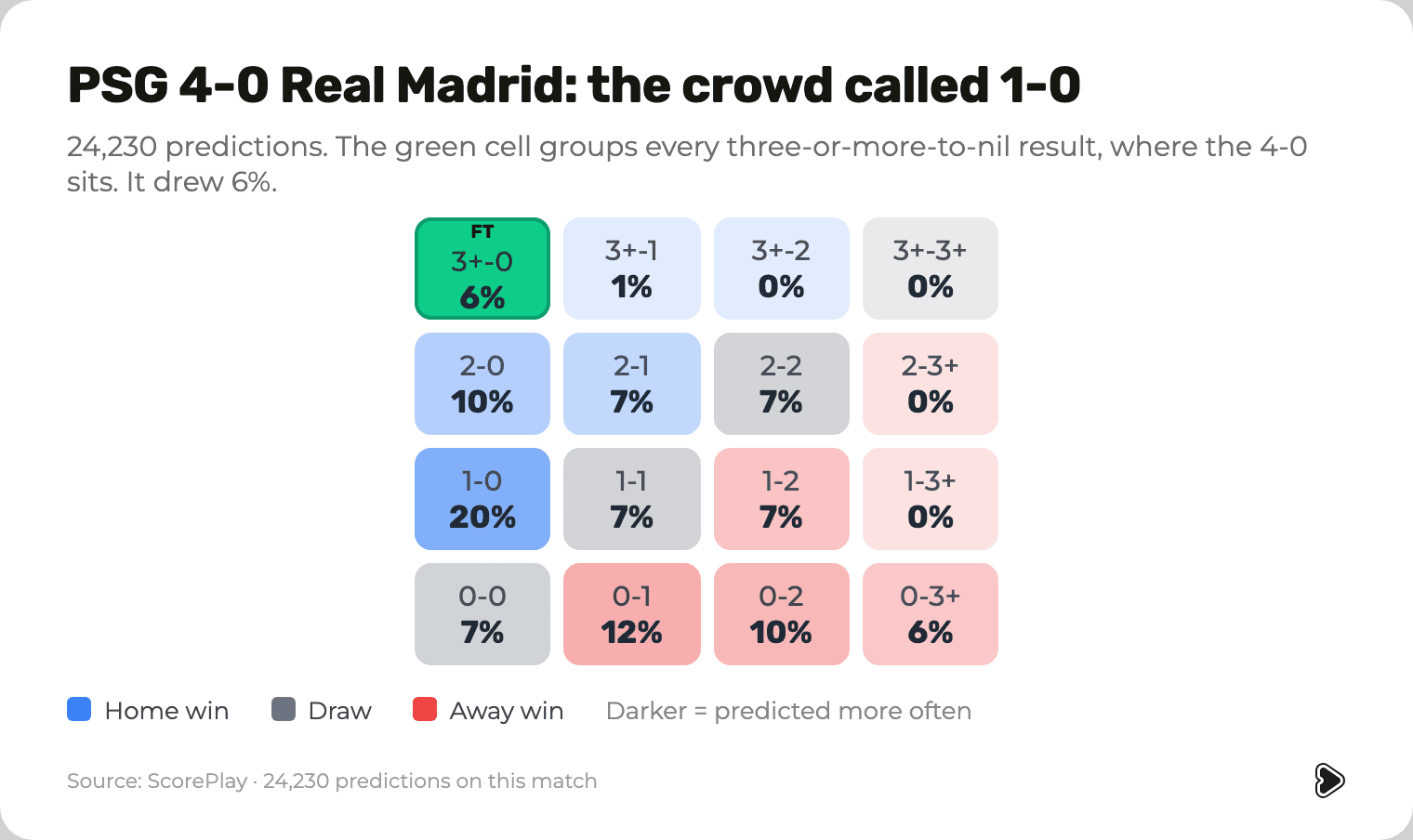
That match drew 24,230 predictions, the most of any in the set. The crowd's favourite was 1-0 at 20%. The actual 4-0 sits in the three-or-more-to-nil zone, which only 6% of players reached. The bigger and more open the game, the safer the crowd plays, and the further the result tends to run from it.
Skill, luck, and the leaderboard
So is calling scores skill or luck? It is skill, and the exact score is the hardest test of it. To check, we scored every player against the crowd on the same matches, which strips out how hard each game was to call, and looked at whether the edge holds up.
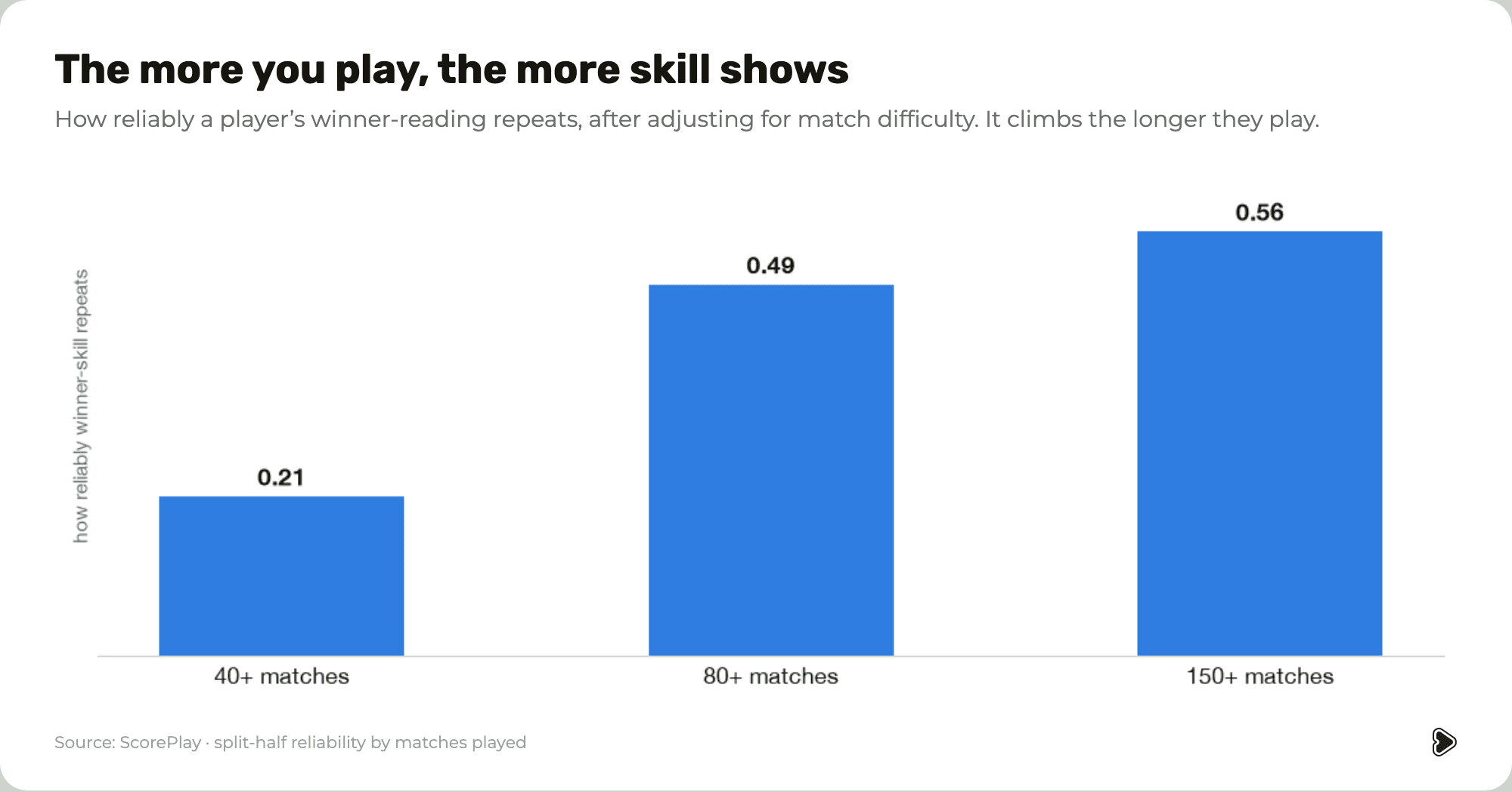
Reading who wins is plainly a skill. A player's edge over the crowd repeats across a random split of their games, and it sharpens the more they play: reliability climbs from 0.21 over forty matches to 0.56 over a hundred and fifty.
The exact score is the same skill, just far harder to show. Match by match it looks like luck, because landing a 6 to 7% shot needs a big sample before any edge appears. So we sorted players by how well they read winners and asked one question: on the same matches, does the stronger group also nail more exact scores than the average player? It does. The weakest readers land about a point below the field on exact scores, the strongest nearly two points above.
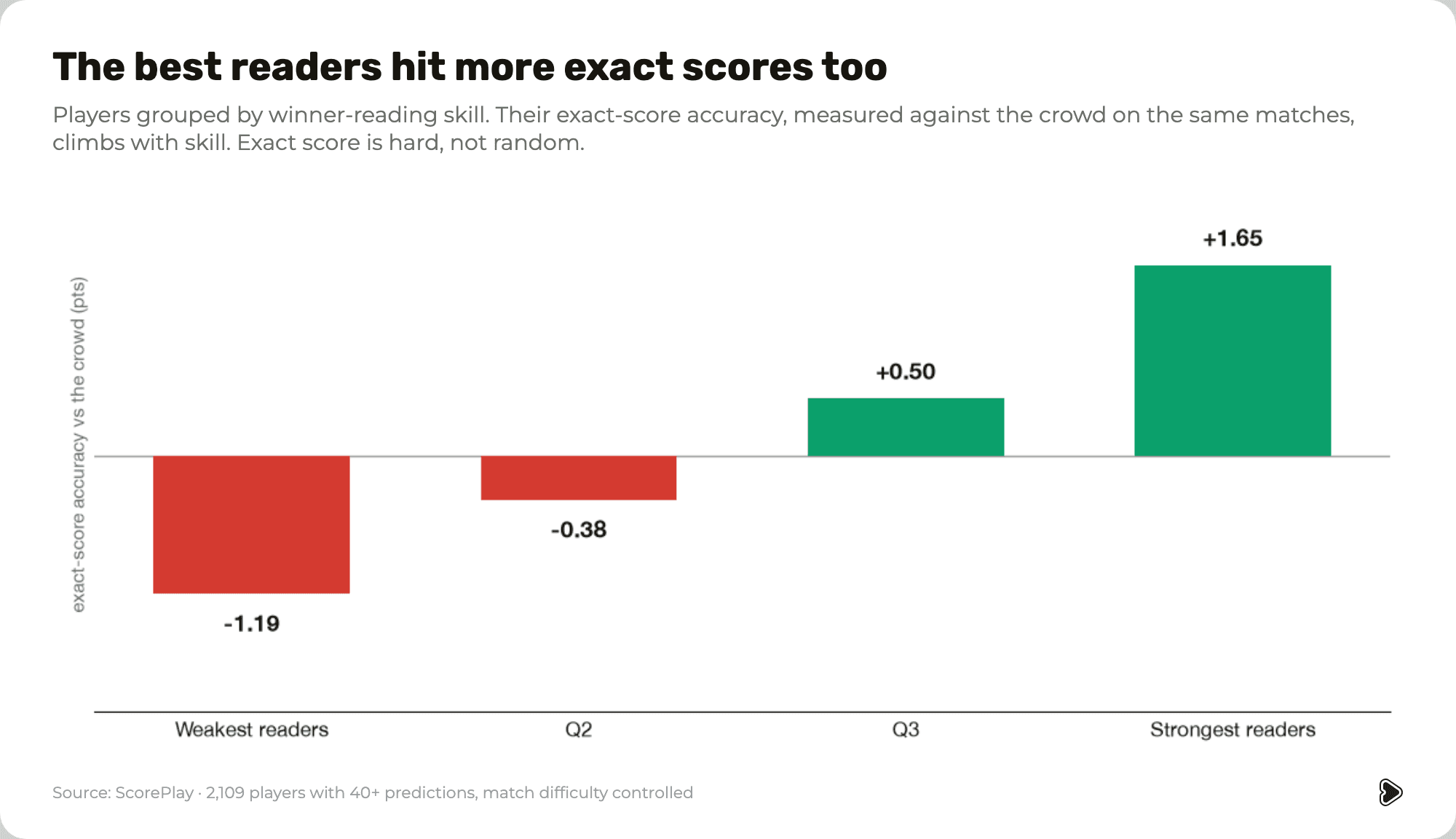
The link holds out of sample: measure a player's winner-reading on one half of their games and it predicts their exact-score accuracy on the other half. The exact score is not a coin flip. It is the hardest call in football, and the people who read the game best make it more often.
That is what the leaderboard measures. One match is noise and a weekend is mostly luck, but a season is a ranking of who reads football best, which is why a single exact score is a thrill and a long run at the top is an argument you can win.
What the best readers do differently
You would expect the top readers to dodge the 1-0 Bias. They do not. The best players lean on 1-0 and 0-1 about as much as everyone else, and they call slightly fewer draws, not more. The bias is human, and almost everyone carries it.
One habit does separate them, and it is the most expensive mistake in the data: backing the away team. Home teams win 45% of matches and away teams win 31%, yet the weakest readers predict an away win 60% of the time. The best readers sit close to what really happens.
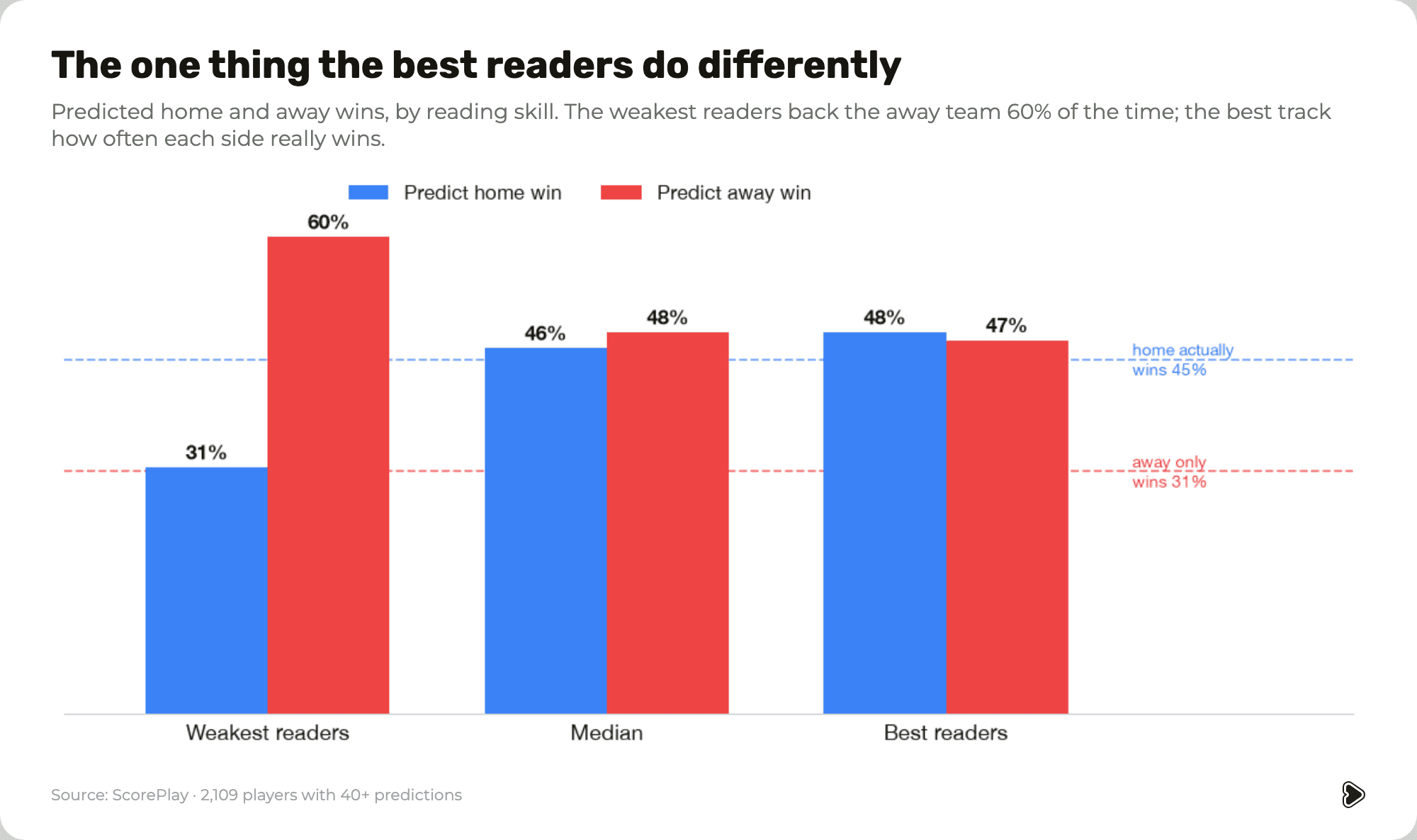
The strongest readers are not running a trick with scorelines. They call each match closer to how football actually behaves, and the clearest sign of a weak reader is over-backing the visitor.
Beating the bias
Three moves, drawn from what actually separates the top of the table from the bottom. None of them swing a single match. Across a season they are the difference.
- Respect home advantage. Home teams win 45% of matches and away teams 31%, yet weak readers back the away side 60% of the time. Fix that one habit and you have closed the biggest gap in the data.
- Read the winner first. It is the part skill rewards most, and it is what the exact score is built on. Get the result right often enough and the scorelines follow.
- Play the long game. One match is luck and a weekend is mostly luck. A season is skill, so the more you call, the more the table reflects how well you read football.
Your turn
The gap between the crowd and the top of the board is real, and it widens the longer you play.
Set up a private league with your group chat, run a season together, and see who is reading the game and who is guessing. Every match has its own page too, like the 2026 World Cup opener. The leaderboard does not lie, given enough matches.
FAQ
What is the 1-0 Bias? Fans predict tidier results than football produces. Across 1.2 million ScorePlay predictions, 1-0 and 0-1 made up nearly a third of all calls, players called a one-goal margin 57% of the time against a real 39%, and draws were called 12% of the time despite happening 25% of the time.
Is calling the exact score skill or luck? Skill, but a very hard one. Match by match it looks like luck because exact scores are rare (6 to 7%), yet the same reading ability that calls winners also lands exact scores: group players by winner-skill and their exact accuracy against the crowd rises from 1.2 points below the field to 1.7 above, and winner-reading on one half of a player's games predicts their exact accuracy on the other half. The leaderboard, over a season, ranks that skill.
Do fans underrate draws? Heavily. Draws happened in 24.9% of matches but were called only 12.4% of the time. The crowd pours the difference into the away win, which it predicted 44.1% of the time against 30.5% real.
What do the best predictors do differently? Mostly one thing: they respect home advantage. Home teams win 45% of matches and away teams 31%, but the weakest readers predict an away win 60% of the time, while the best stay close to reality. They do not avoid the 1-0 habit and they do not call more draws. They read each match closer to how football behaves.
Why does the leaderboard reward skill over a season? Because it is built from hundreds of calls, not one. The noise in any single match averages out while the skill, reading the game, accumulates. Winner-reading reliability rises from 0.21 over forty matches to 0.56 over a hundred and fifty, so the more a player calls, the more their position reflects how well they read football.